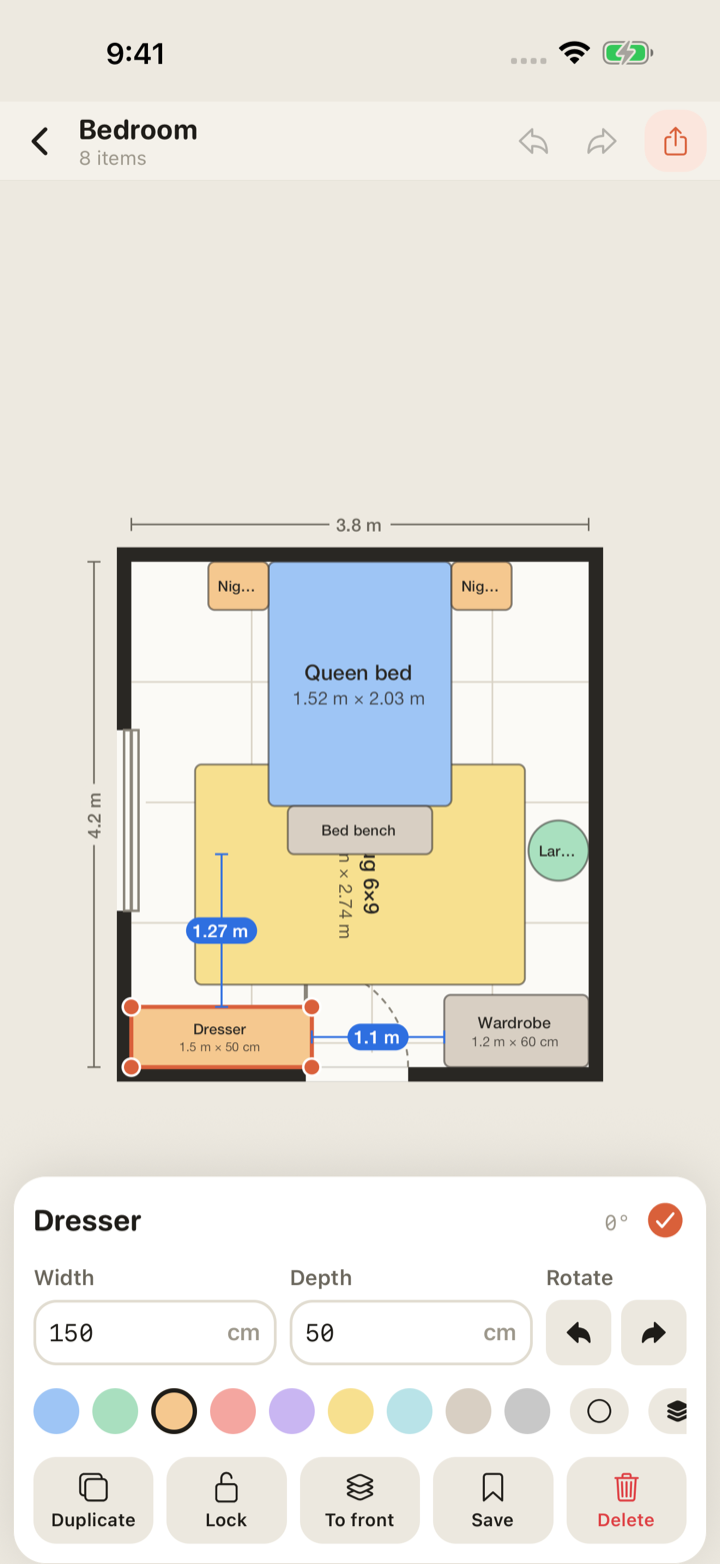
Real bed sizes
| Piece | Width × depth (cm) | Inches | Feet & inches |
|---|---|---|---|
| Twin bed | 99 × 191 cm | 39 × 75 in | 3' 3" × 6' 3" |
| Full bed | 137 × 191 cm | 54 × 75 in | 4' 6" × 6' 3" |
| Queen bed | 152 × 203 cm | 60 × 80 in | 5' 0" × 6' 8" |
| King bed | 193 × 203 cm | 76 × 80 in | 6' 4" × 6' 8" |
| California king bed | 183 × 213 cm | 72 × 84 in | 6' 0" × 7' 0" |
| EU single bed | 90 × 200 cm | 35 × 79 in | 2' 11" × 6' 7" |
| EU double bed | 140 × 200 cm | 55 × 79 in | 4' 7" × 6' 7" |
| EU king bed | 160 × 200 cm | 63 × 79 in | 5' 3" × 6' 7" |
| EU super king bed | 180 × 200 cm | 71 × 79 in | 5' 11" × 6' 7" |
Mattress sizes, as they appear in the Snug library. Add roughly 5 to 10 cm to each side for the frame, or measure your frame and edit the size after placing it.
The three gaps that matter
Interior designers use a handful of clearances for bedrooms, and they are all about being able to move. Snug turns any gap under 60 cm (24 in) amber, which is the point at which you start shuffling sideways.
- Beside the bed: 60 cm (24 in) is the minimum on any side you get out of; 75 cm (30 in) is comfortable. A bed pushed against one wall is fine for one person and a nightly climb for two.
- At the foot of the bed: 60 cm if it is a walkway, 90 cm (36 in) if a wardrobe or dresser faces it, because those drawers and doors need to open.
- In front of the wardrobe: the depth of the door, so 60 cm for a hinged wardrobe, plus enough to stand in. Sliding doors need nothing beyond standing room.
Where the door goes
The classic bedroom mistake is a door that opens into the wardrobe, or a bed whose corner sits inside the door swing. On paper these are easy to miss; a rectangle for the door does not tell you what it sweeps across. Snug draws the swing arc with the hinge side and direction, and you can slide the door along the wall or flip the hinge to see whether the layout works better with the door hinged the other way, a change that costs nothing before the furniture arrives and a lot afterwards.
Windows matter too, mostly for the headboard. A bed under a window is fine for light, less fine for a radiator, and Snug has a radiator in the library (100 × 10 cm) so you can place it and keep the bed off it.
Try two layouts, keep one
The honest way to plan a bedroom is to make two versions: bed on the long wall, bed on the short wall. With Snug Unlimited you duplicate the room, move the bed in the copy, and compare the clearance numbers side by side. Even on the free tier you can do it in one room, since undo and redo are unlimited and every move is reversible.
Questions people ask
- How much space do you need around a bed?
- At least 60 cm (24 in) on each side you get out of, and 75 cm (30 in) is comfortable. Leave 90 cm (36 in) at the foot if a wardrobe or chest of drawers faces it, so the doors and drawers can open.
- Will a queen bed fit in a 3 × 3.5 m bedroom?
- Yes, and with room to spare on one side. A queen is 152 × 203 cm. Against the 3 m wall it leaves 148 cm to split between the two sides, so about 74 cm each, or 60 cm on one side and a nightstand on the other. Snug's "Small bedroom" preset is exactly 3 × 3.5 m.
- Can I see whether the door hits the bed?
- Yes. Doors in Snug draw their swing arc with the hinge side and direction. Slide the door along the wall or flip its hinge and the arc updates immediately.